Top 15 in Science
Week of July 13, 2026
by Paul Robbins
An accessible, focused exploration of the field of political ecology The third edition of Political Ecology spans this sprawling field, using grounded examples and careful readings of current literature. While the study of political ecology is sometimes difficult to fathom, owing to its breadth and diversity, this resource simplifies the discussion by reducing the field down into a few core questions and arguments. These points clearly demonstrate how critical theory can make pragmatic contributions to the fields of conservation, development, and environmental management. The latest edition of this seminal work is also more closely focused, with references to recent work from around the world. Further, Political Ecology raises critical questions about “traditional” approaches to environmental questions and problems. This new edition: Includes international work in the field coming out of Europe, Latin America, and Asia Explains political ecology and its tendency to disrupt the environmental research and practice by both advancing and undermining associated fields of study Contains contributions from a wide range of diverse backgrounds and expertise Offers a resource that is written in highly-accessible, straightforward language Outlines the frontiers of the field and frames climate change and the end of population growth with the framework of political ecology An excellent resource for undergraduates and academics, the third edition of Political Ecology offers an updated edit

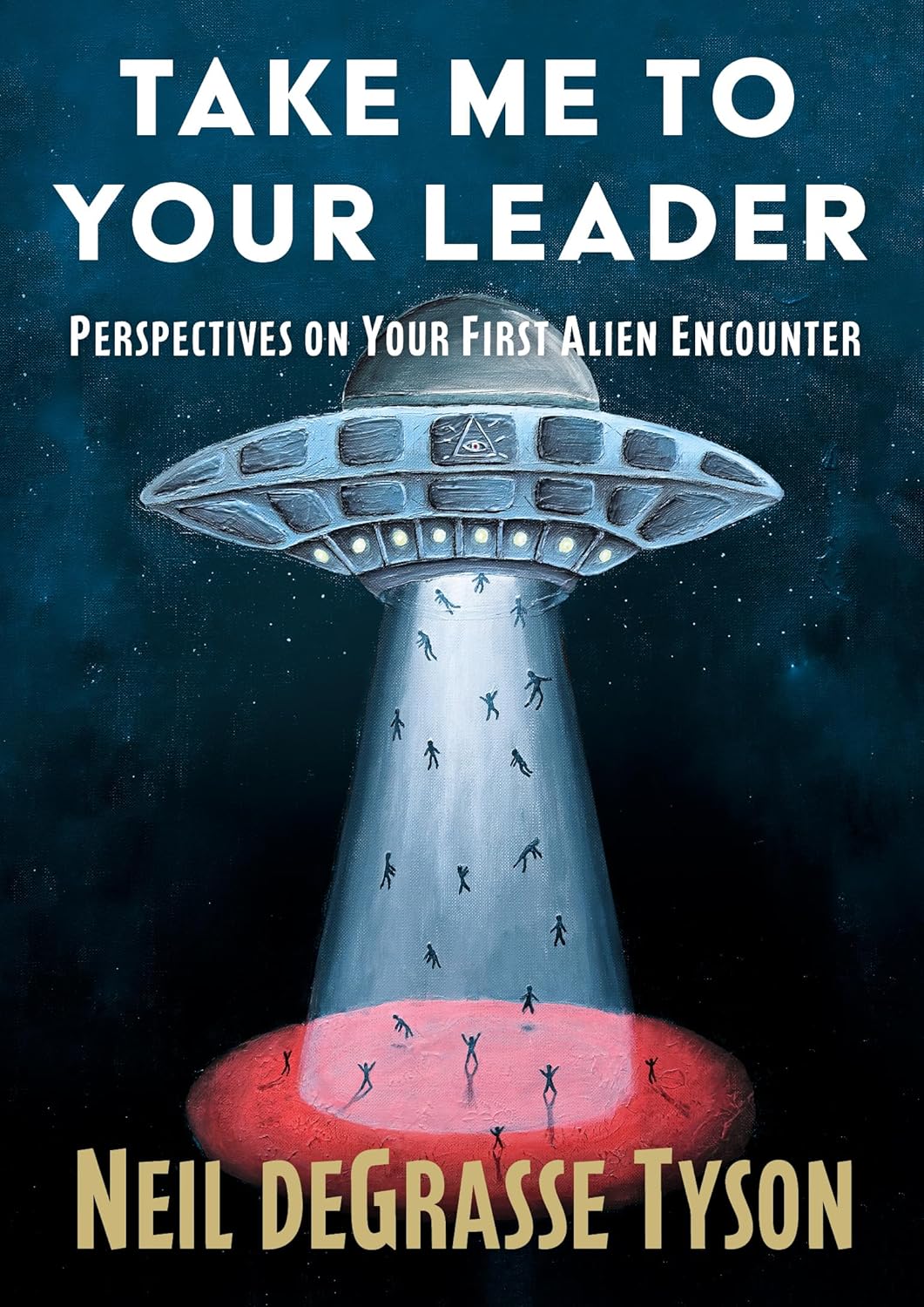
by Neil deGrasse Tyson
The culmination of a lifetime of fascination and speculation, Tyson applies the universal laws of physics to make the case for what aliens might look like, act like, how they might travel, what they might think. Should such an event occur, Tyson offers useful etiquettte tips for your first close encounter.

by Thomas A. Bass
The author of The Eudaemonic Pie now reveals the inspiration, motivations, and aspirations of the world's greatest scientists. The scientists interviewed in this collection have changed the rules of the game--altered our perception of reality and the language used to describe it.

by Timothy Snyder
#1 NEW YORK TIMES BESTSELLER • A “bracing” (Vox) guide for surviving and resisting America’s turn towards authoritarianism, from “a rising public intellectual unafraid to make bold connections between past and present” (The New York Times) “Timothy Snyder reasons with unparalleled clarity, throwing the past and future into sharp relief. He has written the rare kind of book that can be read in one sitting but will keep you coming back to help regain your bearings.”—Masha Gessen The Founding Fathers tried to protect us from the threat they knew, the tyranny that overcame ancient democracy. Today, our political order faces new threats, not unlike the totalitarianism of the twentieth century. We are no wiser than the Europeans who saw democracy yield to fascism, Nazism, or communism. Our one advantage is that we might learn from their experience. On Tyranny is a call to arms and a guide to resistance, with invaluable ideas for how we can preserve our freedoms in the uncertain years to come.
by Stephen P. Maran
When the International Astronomical Union (IAU) adopted a new definition of a "planet" in August 2006, Pluto became a dwarf planet, drawing a divisive line in science and public opinions. The controversy of whether Pluto is a planet continues years later, and passion about the decision remains, pitting scientist against scientist and invoking sentiments and nostalgia from the rest of the world. With the IAU definition, the future of space objects is forever changed. Learn how this resolution came to be and what it means for astronomy, who implemented it and who is against it, and whether it's the first or millionth time the world's view of astronomy has rotated on its axis. Written by an astronomer and educator who voted for the IAU resolution—Laurence A. Marschall—and a NASA scientist who supported the opposing petition that resulted—Stephen P. Maran—Pluto Confidential leaves no perspective out and no asteroid unturned in the Pluto debate. A telescopic look inside the book: History of planetary disputes, including why Jupiter almost wasn't acknowledged What Bode's Law is and how it has influenced observations Who discovered Pluto and how it was named The Kuiper Belt and its role in what it means to be a planet Beyond Pluto and the eight distinguished planets

by Hans Kuhn
Principles of Physical Chemistry, Second Edition uniquely uses simple physical models as well as rigorous treatments for understanding molecular and supramolecular systems and processes. In this way the presentation assists students in developing an intuitive understanding of the subjects as well as skill in quantitative manipulations. The unifying nature of physical chemistry is emphasized in the book by its organization - beginning with atoms and molecules, and proceeding to molecular assemblies of increasing complexity, ending with the emergence of matter that carries information, i.e. the origin of life, a physicochemical process of unique importance. The aim is to show the broad scope and coherence of physical chemistry.

by Michael A. Nielsen
One of the most cited books in physics of all time, Quantum Computation and Quantum Information remains the best textbook in this exciting field of science. This 10th anniversary edition includes an introduction from the authors setting the work in context. This comprehensive textbook describes such remarkable effects as fast quantum algorithms, quantum teleportation, quantum cryptography and quantum error-correction. Quantum mechanics and computer science are introduced before moving on to describe what a quantum computer is, how it can be used to solve problems faster than 'classical' computers and its real-world implementation. It concludes with an in-depth treatment of quantum information. Containing a wealth of figures and exercises, this well-known textbook is ideal for courses on the subject, and will interest beginning graduate students and researchers in physics, computer science, mathematics, and electrical engineering.

by Sara Blair
"The Harlem riot of 1935 not only signaled the end of the Harlem Renaissance; it made black America's cultural capital an icon for the challenges of American modernity. Luring photographers interested in socially conscious, journalistic and aesthetic representation, post-Renaissance Harlem helped give rise to America's full-blown image culture and its definitive genre, documentary. Arguing for Harlem as a crossroads between writers and the image, Sara Blair explores its power for canonical writers, whose work was responsive to the changing meanings and uses of photographs. She examines literary engagements with photography from the 1930s to the 1970s and beyond." --Book Jacket.
by Ernst Cassirer
This provocative volume, one of the most important interpretive works on the philosophical thought of the Renaissance, has long been regarded as a classic in its field. Ernst Cassirer here examines the changes brewing in the early stages of the Renaissance, tracing the interdependence of philosophy, language, art, and science; the newfound recognition of individual consciousness; and the great thinkers of the period—from da Vinci and Galileo to Pico della Mirandola and Giordano Bruno. The Individual and the Cosmos in Renaissance Philosophy discusses the importance of fifteenth-century philosopher Nicholas Cusanus, the concepts of freedom and necessity, and the subject-object problem in Renaissance thought. “This fluent translation of a scholarly and penetrating original leaves little impression of an attempt to show that a ‘spirit of the age’ or ‘spiritual essence of the time’ unifies and expresses itself in all aspects of society or culture.”—Philosophy

by Michael Pollan
The Instant New York Times Bestseller "Pollan’s real genius—the word is not too strong—remains intact. That is his uncanny ability to scent the direction in which the culture is headed. He did it with food and psychedelics, and now, though A World Appears focuses on AI only intermittently, he has done it again." —Charles Finch, The Atlantic From the #1 New York Times bestselling author of How to Change Your Mind, a panoptic exploration of consciousness—what it is, who has it, and why—and a meditation on the essence of our humanity When it comes to the phenomenon that is consciousness, there is one point on which scientists, philosophers, and artists all agree: it feels like something to be us.

by Hans Moravec
"A dizzying display of intellect and wild imaginings by Moravec, a world-class roboticist who has himself developed clever beasts . . . Undeniably, Moravec comes across as a highly knowledgeable and creative talent--which is just what the field needs".--Kirkus Reviews.

by Tom Beer
The second edition of Environmental Oceanography is the first textbook to link the needs of the coastal oceanographer and the environmental practitioner. The ever-increasing human impact on the environment, and particularly on the coastal zone, has led governments to carefully examine the environmental implications of development proposals. This book provides the background needed to undertake coastal oceanographic investigations and sets them in context by incorporating case studies and sample problems based on the author's experience as an environmental consultant.

by Joshua Schimel
This book takes an integrated approach, using the principles of story structure to discuss every aspect of successful science writing, from the overall structure of a paper or proposal to individual sections, paragraphs, sentences, and words. It begins by building core arguments, analyzing why some stories are engaging and memorable while others are quickly forgotten, and proceeds to the elements of story structure, showing how the structures scientists and researchers use in papers and proposals fit into classical models. The book targets the internal structure of a paper, explaining how to write clear and professional sections, paragraphs, and sentences in a way that is clear and compelling.

by Rachel Carson
Presents Rachel Carson's 1962 environmental classic "Silent Spring," which identified the dangers of indiscriminate pesticide use; and includes an introduction by biographer Linda Lear and an afterword by scientist Edward O. Wilson.

by Joseph Warren Dauben
One of the greatest revolutions in mathematics occurred when Georg Cantor (1845-1918) promulgated his theory of transfinite sets. This revolution is the subject of Joseph Dauben's important studythe most thorough yet writtenof the philosopher and mathematician who was once called a "corrupter of youth" for an innovation that is now a vital component of elementary school curricula. Set theory has been widely adopted in mathematics and philosophy, but the controversy surrounding it at the turn of the century remains of great interest. Cantor's own faith in his theory was partly theological. His religious beliefs led him to expect paradoxes in any concept of the infinite, and he always retained his belief in the utter veracity of transfinite set theory. Later in his life, he was troubled by recurring attacks of severe depression. Dauben shows that these played an integral part in his understanding and defense of set theory.