
Top 15 in Sci-Fi
What could an omnipresent and seemingly omnipotent entity want with a humble pot-healer? Or with the dozens of other odd creatures it has lured to Plowman's Planet? And if the Glimmung is a god, are its ends positive or malign? Combining quixotic adventure, spine-chilling horror, and deliriously paranoid theology, Galactic Pot-Healer is a uniquely Dickian voyage to alternate worlds of the imagination.

by Greg Bear
Greg Bear is one of the greatest science fiction writers of the late twentieth century. He has a powerful voice, combining the intense rationality of science with the intensely passionate characters that can only be created by a writer who loves humanity. Bear’s novel Moving Mars won the Nebula Award in 1994, and he did it again, in 2000, with Darwin’s Radio. He has been honored with Hugo and Nebula nominations for novel-length work eight more times. But Greg Bear’s short fiction is even more astounding, as this powerful career retrospective demonstrates. This collection contains Bear’s earliest published fiction from the late 1960s and early 1970s as well his remarkable award-winning work from the ‘80s and ‘90s—stories like the Hugo and Nebula Award-winning novella- length version of “Blood Music” and the Hugo and Nebula Award-winner “Tangents.” This Collection is enhanced by brand-new introductions for each story, commentary, and reminiscences by Greg Bear.

Carl Freedman traces the fundamental and mostly unexamined relationships between the discourses of science fiction and critical theory, arguing that science fiction is (or ought to be) a privileged genre for critical theory. He asserts that it is no accident that the upsurge of academic interest in science fiction coincides with the heyday of literary theory, and that likewise science fiction is one of the most theoretically informed areas of the literary profession. His readings of novels by five important modern science fiction authors (Stanislaw Lem, Ursula LeGuin, Joanna Russ, Samuel Delany, and Philip K. Dick) illustrate the affinity between science fiction and critical theory, in each case concentrating on a novel that resonates with critical theory concerns.

A biography of the science fiction writer, presented by his son, describes Herbert's childhood in Tacoma, Washington, his early years as a reporter and editor, his military service, and his struggles to become published.

by Gene Wolfe
Gene Wolfe's Return to the Whorl is the third volume, after On Blue's Waters and In Green's Jungles, of his ambitious SF trilogy The Book of the Short Sun . . . It is again narrated by Horn, who has embarked on a quest in search of the heroic leader Patera Silk. Horn has traveled from his home on the planet Blue, reached the mysterious planet Green, and visited the great starship, the Whorl and even, somehow, the distant planet Urth. But Horn's identity has become ambiguous, a complex question embedded in the story, whose telling is itself complex, shifting from place to place, present to past. Perhaps Horn and Silk are now one being. Return to the Whorl brings Wolfe's major new fiction, The Book of the Short Sun, to a strange and seductive climax.

Captures the strange world of twenty-first-century Earth, a devastated planet in which sophisticated androids, banned from the planet, fight back against their potential destroyers, while bounty hunter Rick Deckard sets out to track down the replicants. Reissue. (Tie-in to the Fall 2007 release of the deluxe twenty-fifth anniversary DVD of the Warner Bros. film, directed by Ridley Scott, starring Harrison Ford, Rutger Hauer, Sean Young, and others) (Science Fiction)

The Wheel of Times turns and Ages come and go, leaving memories that become legend. Legend fades to myth, and even myth is long forgotten when the Age that gave it birth returns again. In the Third Age, and Age of Prophecy, the World and Time themselves hang in the balance. What was, what will be, and what is, may yet fall under the Shadow.
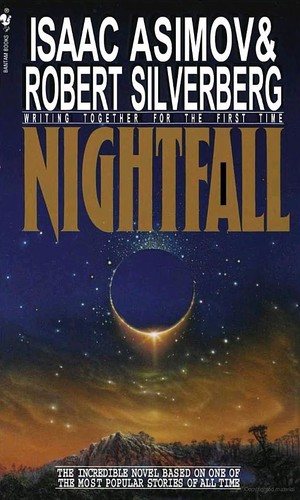
by Isaac Asimov
An expanded version of Asimov's short story, "Nightfall," reveals a world on the brink of chaos, torn between religious fanaticism and scientific denial and faced with the end of civilization

by Ken Liu
Presents the author's selection of his best short stories, as well as a new piece, in a collection that includes "The Man Who Ended History: A Documentary," "Mono No Aware" and "The Waves."

Trurl and Klaupacius are constructor robots who try to out-invent each other. They travel to the far corners of the cosmos to take on freelance problem-solving jobs, with dire consequences for their employers. "The most completely successful of his books... here Lem comes closest to inventing a real universe" (Boston Globe). Illustrations by Daniel Mr--z. Translated by Michael Kandel.

Parable of the Talents celebrates the classic Butlerian themes of alienation and transcendence, violence and spirituality, slavery and freedom, separation and community, to astonishing effect, in the shockingly familiar, broken world of 2032. Long awaited, Parable of the Talents is the continuation of the travails of Lauren Olamina, the heroine of 1994's Nebula-Prize finalist, bestselling Parable of the Sower. Parable of the Talents is told in the voice of Lauren Olamina's daughter&...from whom she has been separated for most of the girl's life&...with sections in the form of Lauren's journal. Against a background of a war-torn continent, and with a far-right religious crusader in the office of the U.S. presidency, this is a book about a society whose very fabric has been torn asunder, and where the basic physical and emotional needs of people seem almost impossible to meet.

by Pierce Brown
Red Rising thrilled readers and announced the presence of a talented new author. Golden Son changed the game and took the story of Darrow to the next level. Now comes the exhilarating conclusion to the Red Rising Trilogy.

by Carl Sagan
In the year 1999 a multinational team of astronauts sets out to discover the secrets of the universe.

by Dan Simmons
The first installment of a new saga based on themes from "The Iliad" and "The Tempest" places classical characters and gods in such settings as the Plains of Ilium, the terraformed oceans of Mars, and Jupiter space.
