
Top 15 in Science
by Hans Moravec
"A dizzying display of intellect and wild imaginings by Moravec, a world-class roboticist who has himself developed clever beasts . . . Undeniably, Moravec comes across as a highly knowledgeable and creative talent--which is just what the field needs".--Kirkus Reviews.

Presents Rachel Carson's 1962 environmental classic "Silent Spring," which identified the dangers of indiscriminate pesticide use; and includes an introduction by biographer Linda Lear and an afterword by scientist Edward O. Wilson.
When the International Astronomical Union (IAU) adopted a new definition of a "planet" in August 2006, Pluto became a dwarf planet, drawing a divisive line in science and public opinions. The controversy of whether Pluto is a planet continues years later, and passion about the decision remains, pitting scientist against scientist and invoking sentiments and nostalgia from the rest of the world. With the IAU definition, the future of space objects is forever changed. Learn how this resolution came to be and what it means for astronomy, who implemented it and who is against it, and whether it's the first or millionth time the world's view of astronomy has rotated on its axis. Written by an astronomer and educator who voted for the IAU resolution—Laurence A. Marschall—and a NASA scientist who supported the opposing petition that resulted—Stephen P. Maran—Pluto Confidential leaves no perspective out and no asteroid unturned in the Pluto debate. A telescopic look inside the book: History of planetary disputes, including why Jupiter almost wasn't acknowledged What Bode's Law is and how it has influenced observations Who discovered Pluto and how it was named The Kuiper Belt and its role in what it means to be a planet Beyond Pluto and the eight distinguished planets

The New York Times bestselling author and former U.S. Attorney offers a piercing exposé on the escalating threat of far-right politics—and a clear roadmap for saving our democracy. In The Fix, McQuade draws on her decades of experience as a federal prosecutor to reveal how systems of organized crime and political opportunism exploit the levers of power—using corruption, cruelty, and chaos as tools to dominate institutions and eliminate accountability. With clarity, precision, and moral force, she exposes the tactics of today’s far-right MAGA system: information warfare, aggressive retribution, conformism enforced by fear, and pervasive dismantling of legal checks and balances necessary to defend the public interest and uphold justice. Weaving together courtroom stories, real-time political analysis, and cautionary lessons from history and democratic backsliding abroad, McQuade makes the case that the threats we face are not future possibilities—they’re already here. Yet The Fix is not just a warning; it is a call to action. In the book’s final chapters, McQuade outlines common-sense reforms and strategies that can reclaim the rule of law and recenter democracy with the power of the people. Accessible, eye-opening, and grounded in constitutional faith, The Fix is essential reading for everyone concerned about the future of America—and ready to work together to take a stand for it.

by Max Born
A Nobel Prize-winning physicist explains the historical background and scientific principles of Einstein's famous theory

The author of The Eudaemonic Pie now reveals the inspiration, motivations, and aspirations of the world's greatest scientists. The scientists interviewed in this collection have changed the rules of the game--altered our perception of reality and the language used to describe it.

"Scientists have recently discovered shards of the flu virus in human remains frozen in the Arctic tundra and in scraps of tissue preserved in a government warehouse. In Flu, Gina Kolata, reporter for The New York Times, unravels the mystery of this lethal virus with the high drama of a great adventure story. From Alaska to Norway, from the streets of Hong Kong to the corridors of the White House, Kolata tracks the race to recover the live pathogen and probes the fear that has impelled government policy. She delves into the history of the flu and previous epidemics, profiles the experts hot on the trail and the amateurs woefully misguided, and details the science and the latest understanding of this mortal disease."--BOOK JACKET.Title Summary field provided by Blackwell North America, Inc. All Rights Reserved

#1 NEW YORK TIMES BESTSELLER • A “bracing” (Vox) guide for surviving and resisting America’s turn towards authoritarianism, from “a rising public intellectual unafraid to make bold connections between past and present” (The New York Times) “Timothy Snyder reasons with unparalleled clarity, throwing the past and future into sharp relief. He has written the rare kind of book that can be read in one sitting but will keep you coming back to help regain your bearings.”—Masha Gessen The Founding Fathers tried to protect us from the threat they knew, the tyranny that overcame ancient democracy. Today, our political order faces new threats, not unlike the totalitarianism of the twentieth century. We are no wiser than the Europeans who saw democracy yield to fascism, Nazism, or communism. Our one advantage is that we might learn from their experience. On Tyranny is a call to arms and a guide to resistance, with invaluable ideas for how we can preserve our freedoms in the uncertain years to come.

One of the most cited books in physics of all time, Quantum Computation and Quantum Information remains the best textbook in this exciting field of science. This 10th anniversary edition includes an introduction from the authors setting the work in context. This comprehensive textbook describes such remarkable effects as fast quantum algorithms, quantum teleportation, quantum cryptography and quantum error-correction. Quantum mechanics and computer science are introduced before moving on to describe what a quantum computer is, how it can be used to solve problems faster than 'classical' computers and its real-world implementation. It concludes with an in-depth treatment of quantum information. Containing a wealth of figures and exercises, this well-known textbook is ideal for courses on the subject, and will interest beginning graduate students and researchers in physics, computer science, mathematics, and electrical engineering.
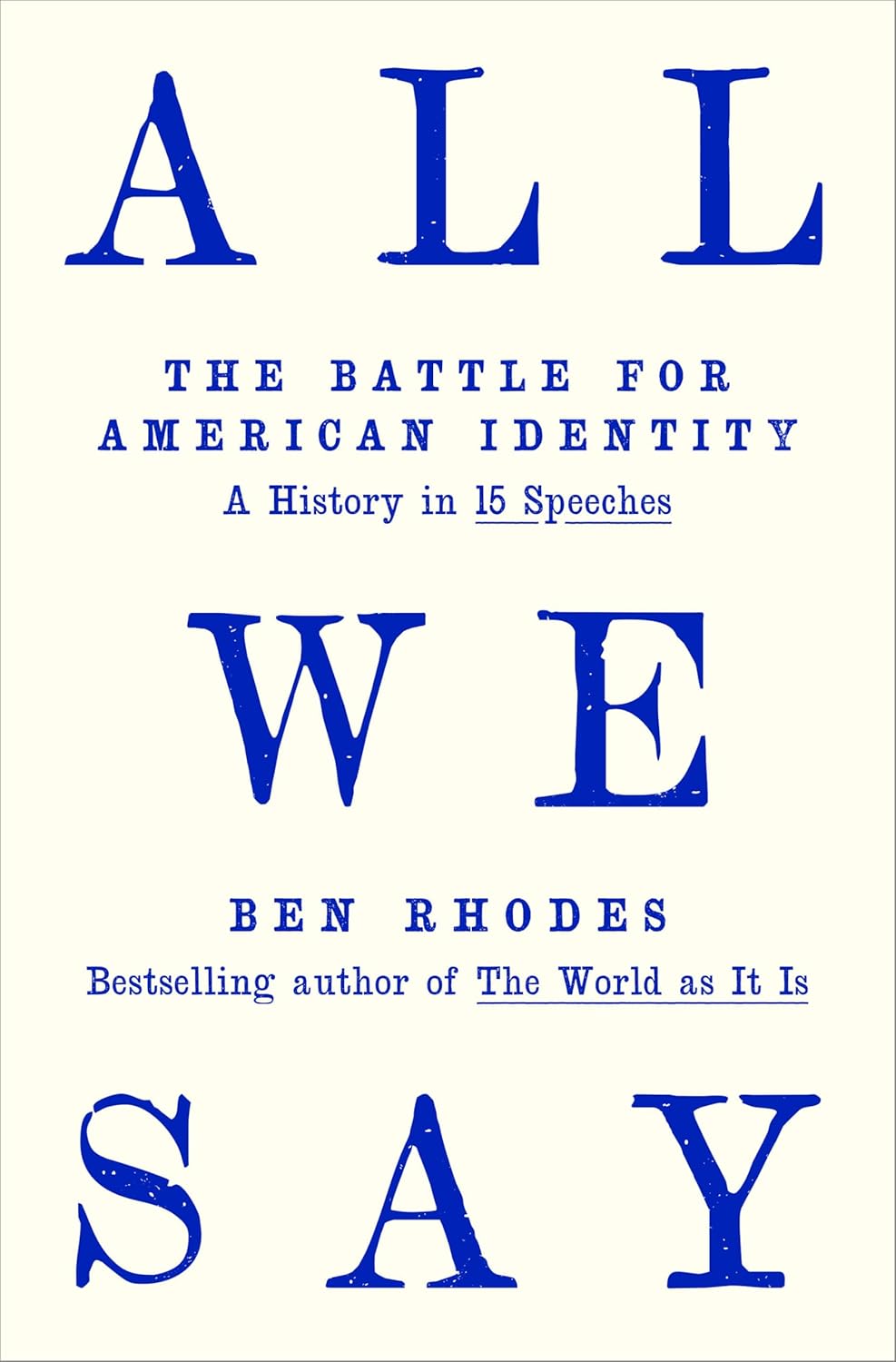
by Ben Rhodes
What does it mean to be American? Who gets to decide? This sweeping history of the United States told through fifteen speeches relives the battle over American identity, from a New York Times bestselling author and one of President Barack Obama’s former speechwriters. “At a time of moral and political drift, Ben Rhodes reminds us what American greatness actually sounds like, and what it means.”—Ayad Akhtar, author of Homeland Elegies For 250 years, we have debated what it means to be American. This question shaped the compromises in our Constitution and the arguments we’ve been having ever since—spawning abolitionism, secession, and civil war; populism, mass migration, and global leadership; movements for reform and the backlashes to them. In All We Say, Ben Rhodes tells the story of fifteen speeches—some iconic, others long forgotten—which have both shaped and reflected the argument Americans have been having from our founding to the intense divisions of our time. Through riveting and beautifully rendered accounts of the people, movements, and moments that produced these speeches, Rhodes traces the history of our battle over identity. The result is a singular and revealing portrait of America itself: a nation divided between two stories—one of inheritance, power, and exclusion, the other of equality, striving, and belonging. Drawing on a decade writing for Barack Obama, Rhodes also shows us how words can redirect a nation, what makes a speech enduring, and why oratory is a unique form of persuasion in American democracy. From Benjamin Franklin’s call for compromise at the Constitutional Convention, to Alexander Stephens’ case for white supremacy as the cornerstone of the Confederacy;.
The New York Times bestselling author of Begin Again confronts America’s unfinished story in this blistering reassessment of race, freedom, and the myths that bind us. “A thoughtful, insightful, beautifully written book that is timely and welcomed in these perilous times.”—Bryan Stevenson, #1 New York Times bestselling author of Just Mercy “Eddie S. Glaude Jr. opens a necessary conversation as we reflect on the meaning of our country’s 250th anniversary.”—Annette Gordon-Reed, Pulitzer Prize– and National Book Award–winning author of The Hemingses of Monticello Celebrated public intellectual Eddie S. Glaude, Jr. presents a groundbreaking analysis of the vicious cycles of American history and the country’s enduring refusal to face its true nature—especially at the moments when national anniversaries steer us back toward the mythology meant to disguise the truth. America, U.S.A., deliberately formulated and beautifully written, details a heart-wrenching exploration of America’s legacy. It is a magnificently complex combination of lessons and voices—from W.E.B. DuBois and John Dos Passos to Herman Melville and Martin Luther King, Jr.—that, together, paint a sprawling and honest tableau of the United States, its complicated past, and ever more tenuous future. Glaude’s is a powerful voice of conscience in our tumultuous world. He pulls no punches, calling on us to interrogate our conceptions of innocence and freedom and the stories we tell ourselves about our past and present. Centered around the major celebrations of America’s milestone birthdays across 250 years of history, the book offers a riveting look at the battles over who has a stake in writing the American story. Devastatingly candid, profoundly moving, and deeply reflective, America, U.S.A. is a shining meditation on how we must reckon with a grim past in order to strive for the better angels of our future.
This provocative volume, one of the most important interpretive works on the philosophical thought of the Renaissance, has long been regarded as a classic in its field. Ernst Cassirer here examines the changes brewing in the early stages of the Renaissance, tracing the interdependence of philosophy, language, art, and science; the newfound recognition of individual consciousness; and the great thinkers of the period—from da Vinci and Galileo to Pico della Mirandola and Giordano Bruno. The Individual and the Cosmos in Renaissance Philosophy discusses the importance of fifteenth-century philosopher Nicholas Cusanus, the concepts of freedom and necessity, and the subject-object problem in Renaissance thought. “This fluent translation of a scholarly and penetrating original leaves little impression of an attempt to show that a ‘spirit of the age’ or ‘spiritual essence of the time’ unifies and expresses itself in all aspects of society or culture.”—Philosophy

The Instant New York Times Bestseller "Pollan’s real genius—the word is not too strong—remains intact. That is his uncanny ability to scent the direction in which the culture is headed. He did it with food and psychedelics, and now, though A World Appears focuses on AI only intermittently, he has done it again." —Charles Finch, The Atlantic From the #1 New York Times bestselling author of How to Change Your Mind, a panoptic exploration of consciousness—what it is, who has it, and why—and a meditation on the essence of our humanity When it comes to the phenomenon that is consciousness, there is one point on which scientists, philosophers, and artists all agree: it feels like something to be us.

Conservation Biology for All provides cutting-edge but basic conservation science to a global readership. A series of authoritative chapters have been written by the top names in conservation biology with the principal aim of disseminating cutting-edge conservation knowledge as widely as possible. Important topics such as balancing conversion and human needs, climate change, conservation planning, designing and analyzing conservation research, ecosystem services, endangered species management, extinctions, fire, habitat loss, and invasive species are covered. Numerous textboxes describing additional relevant material or case studies are also included. The global biodiversity crisis is now unstoppable; what can be saved in the developing world will require an educated constituency in both the developing and developed world. Habitat loss is particularly acute in developing countries, which is of special concern because it tends to be these locations where the greatest species diversity and richest centres of endemism are to be found. Sadly, developing world conservation scientists have found it difficult to access an authoritative textbook, which is particularly ironic since it is these countries where the potential benefits of knowledge application are greatest. There is now an urgent need to educate the next generation of scientists in developing countries, so that they are in a better position to protect their natural resources.
